The $5,000 Tax Line in Healdsburg Vineyard Listings, and the Contract That Comes With It
September 10, 2026
September 10, 2026
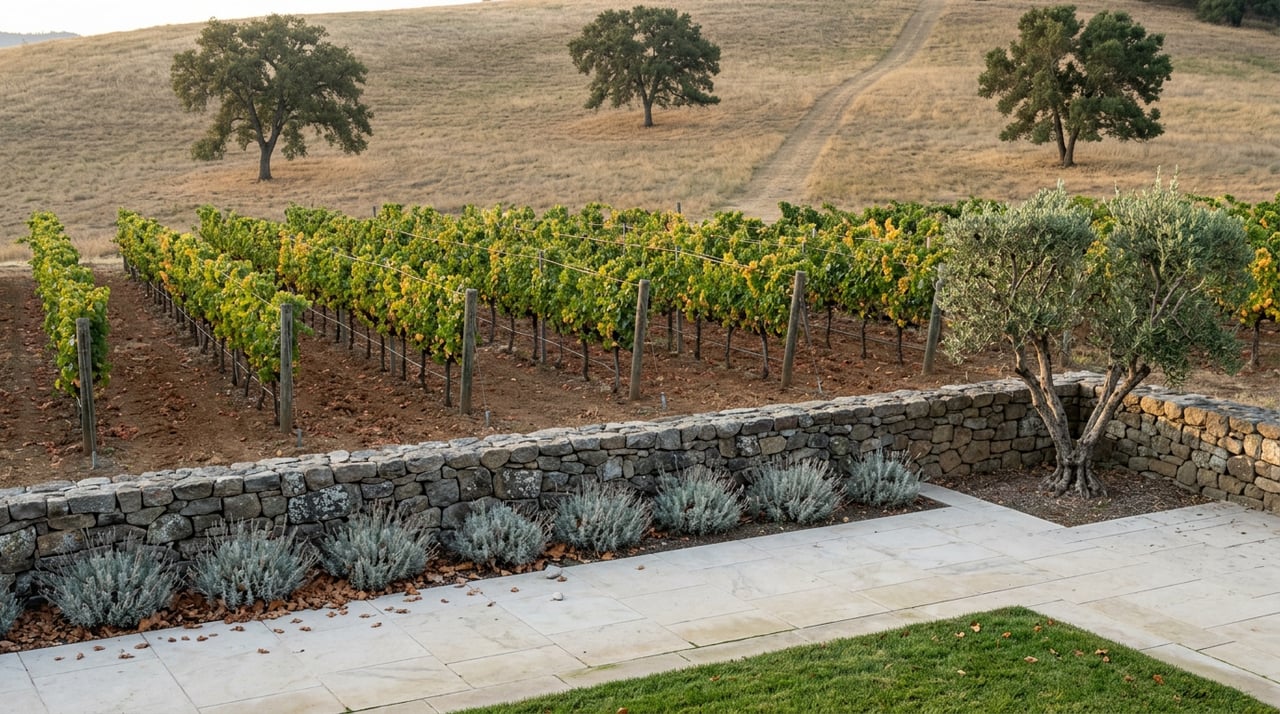
Scroll through vineyard listings in Dry Creek Valley long enough and you will hit one that stops you mid-scroll. Two adjoining parcels, roughly 28 acres total, 25 of them planted to Zinfandel, Cabernet Sauvignon, Merlot, Petite Sirah, and Malbec. The listing states the vines generate more than $200,000 a year for the current owners. Then, almost as an aside, it notes the property tax bill: about $5,000 a year, held there by a long-term Williamson Act enrollment that stays with the land no matter who buys it.
That gap between income and tax bill is the number that gets people calling their agent. It should. But the tax line isn't a bonus a seller threw in. It's the visible edge of a recorded legal contract that already decided some of what you can and cannot do with that land, before you ever wrote an offer.
A Williamson Act contract, formally the California Land Conservation Act of 1965, is an agreement between a landowner and the county. In exchange for keeping land in agricultural or open space use, the county assesses property taxes on farming income rather than full market value. Sonoma County administers these contracts through Permit Sonoma, and the recorded agreement runs with the parcel, not the person who signed it.
That last part is the piece buyers skip past. When you close on a Williamson Act property, you don't get offered the contract. You inherit it, restrictions included, the same way you'd inherit an easement or a deed restriction. The lower tax bill and the limits on what you can build arrive as a package, and no amount of negotiating changes that at closing. If you want a different deal, that conversation has to happen with the county, not the seller.
Not every parcel with vines can carry this contract, and the minimums matter if you're trying to figure out whether a listing you're eyeing is a candidate. A Type I contract, the one built for vineyards and orchards, requires at least 10 acres with a minimum of 50 percent planted in permanent crops. Type II contracts cover land less suited to intensive agriculture, like grazing or open space, and carry different thresholds.
| Contract Type | Minimum Parcel Size | Core Requirement |
|---|---|---|
| Type I | 10 acres | At least 50% in permanent crops (vines, orchards) |
| Type II | 40 acres | Land less suited to intensive agricultural production |
Sonoma County also prefers to see at least 100 contiguous acres under contract when multiple parcels are involved, which is one reason the larger legacy ranches around Healdsburg, the ones that have been in a single family for decades, are more likely candidates than a freshly subdivided five-acre lot.
Here's the part that rarely makes it into a listing description. State law imposes a penalty equal to 25 percent of the unrestricted value of the land for new structures or additions built on a Williamson Act parcel without confirming they're compatible with the contract first. Not 25 percent of the cost of the addition. Twenty-five percent of what the land itself would be worth without the restriction.
That is the real number a buyer should be weighing against the tax savings, because it changes the math on nearly every plan that isn't strictly agricultural. A guest house for family. A detached office. A second residence for a caretaker or vineyard manager beyond what the contract already allows. Each of these needs a compatible-use determination from Permit Sonoma before a shovel goes in the ground, not after.
Wine country lifestyle buyers often picture a working vineyard doubling as an event space, weddings under the pergola, a tasting room in the old barn. On Williamson Act land, that picture runs into the contract's actual language. Special events are only permitted when they're directly tied to agricultural education or the promotion and sale of commodities grown on the contracted land itself. A wedding, on its own, doesn't qualify just because it happens between rows of vines.
This has generated real disputes in Sonoma County, where some owners of Williamson Act properties have argued that wedding events count as agricultural promotion in order to keep hosting them while retaining the tax benefit. As one local piece on the issue put it, "most couples do not think of their weddings as events designed to sell agricultural products." The county doesn't automatically agree that they are, either. If income from events is part of your plan for a vineyard purchase, get the compatible-use question answered in writing before you count on that revenue.
Contracts renew automatically every year unless someone, the landowner or the county, files a formal Notice of Non-Renewal. Filing one doesn't end the restrictions immediately. It starts a phase-out period during which property taxes climb gradually toward full market value over roughly ten years, while the use restrictions stay in place the entire time.
There's a faster route, cancellation, but it's discretionary. The county has to find that cancellation serves the public interest, and it isn't a guarantee just because an owner wants out. For a buyer thinking about future flexibility, subdividing later, building beyond agricultural use, eventually developing part of the parcel, that flexibility isn't available on a normal timeline. It's available on the county's timeline, and the county's timeline is measured in years, not escrow days.
Pricing context matters here too, because the tax savings only make sense against what you're paying for the land itself. Small vineyard properties across Sonoma County are generally running $1.5 million to $3.5 million or more as of early 2026, with parcels close to Healdsburg in Dry Creek Valley and Russian River Valley commanding the higher end of that range due to established vines and proximity to town. Broader land inventory around Healdsburg is currently averaging somewhere in the $50,000 to $53,000 per acre range, based on active listings.
None of that pricing tells you whether a specific parcel carries a Williamson Act contract. That detail lives on the title report and on the assessor's parcel map, where enrolled land is typically labeled an "Ag Preserve." It's a five-minute check that should happen before you fall in love with a $5,000 tax bill that may or may not be doing what you think it's doing for a parcel that size.
Before writing an offer on anything with vines, ask the seller's agent directly whether the parcel carries a Williamson Act contract, and if so, get written confirmation from the county of the enrollment date, contract type, and any pending non-renewal. Pull the permit history for the parcel. If your plans include a second structure, a tasting room, or event income, get a compatible-use determination before you finalize financing around assumptions that contract may not support.
The tax savings are real. So is the timeline it takes to walk away from the restrictions if your plans change five years from now. Treat both as part of the purchase price, because functionally, they are.
Does the tax benefit transfer automatically when I buy the property? Yes. The contract runs with the land, so a new owner inherits both the reduced tax assessment and the use restrictions without any separate application.
Can I still build a house on Williamson Act land? Generally yes, for agricultural employee housing or a primary farm dwelling consistent with the contract, but additional structures typically require a compatible-use determination from Permit Sonoma first.
Can I host tastings or events to generate extra income? Only if the activity is directly tied to promoting or selling agricultural products grown on the property. Confirm this in writing with the county before counting on that income.
How long does it take to exit a Williamson Act contract? Non-renewal triggers a phase-out where taxes rise over roughly ten years while restrictions remain. Cancellation is possible but discretionary, and not guaranteed.
Vineyard and land purchases around Healdsburg carry more moving parts than the listing photos suggest, and the Williamson Act is one of the pieces worth understanding before you're deep into escrow. If you're weighing a parcel in Dry Creek Valley, Alexander Valley, or anywhere else in the Healdsburg area and want a second set of eyes on what a specific contract actually allows, Ceci Cook can walk through the parcel history with you. Let's Connect.
Primary phone
(650) 868-9188License Number
#01159739Address
109 Mill St,Stay up to date on the latest real estate trends.

These Are Healdsburg’s Best Green Spaces and Parks.
Why Timing Your Healdsburg Home Sale Makes All the Difference.
A Culinary Destination in the Heart of Wine Country.
Experience exceptional real estate service with Ceci, dedicated to helping you achieve your goals in the San Francisco Bay Area and Wine Country. Contact her today to get started!